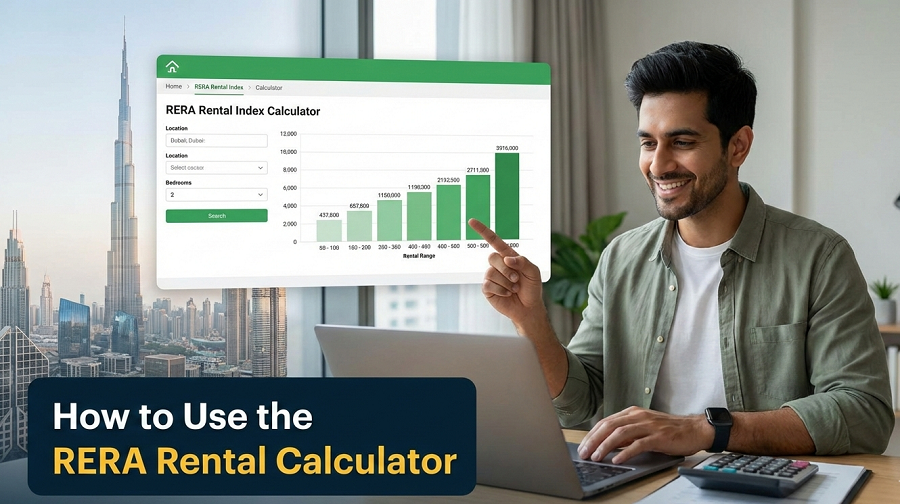
Dubai has a large and diverse real estate market. Although it offers lots of options to everyone, it has some difficulties and risks for buyers, tenants, and even property owners.
One of the biggest concerns of tenants is the rental value of a property. This makes them stressful and raises uncertainty in the rental market of Dubai.
That’s why the Dubai Land Department has come up with an idea to help tenants and landlords estimate the rental value of a property.
The RERA Rental Calculator is a simple but useful tool that reduces risks and disputes between tenants and property owners in Dubai.

Let’s learn what the RERA Rental Calculator is and how it works.
What Is the RERA Rental Calculator?
The RERA Rental Calculator is an online tool that simplifies the process of estimating the rental value of a property in Dubai.
The main purpose of this online calculator is simple but impactful. It uses some data, including the Dubai Rental Index, to determine how much rent a landlord can legally charge or increase for their property.
Who Needs the RERA Rental Calculator?
This is extremely helpful for both tenants and landlords.
It acts as a safeguard for tenants because it regulates rents and prevents sudden or unfair rent hikes. In fact, this calculator makes rent expectations, which is vital for tenants, especially those who have limited income.
The Rental Calculator is also beneficial for landlords because it provides a clear framework to change rents without risking disputes. In fact, landlords can be sure that their rent value is compliant with legal limits and won’t face governmental fines.
Overall, the RERA Rental Calculator keeps the Dubai rental market stable and fair. That’s one of the most important reasons why Dubai has a predictable real estate market, compared to other large cities.
Who Developed the Online Rental Calculator for Dubai?
This online tool has been designed by the Real Estate Regulatory Agency (RERA), which is a government agency that regulates the real estate sector in Dubai.
This agency is operating under the Dubai Land Department (DLD), a government body responsible for all property matters in Dubai.
It’s good to know that very few cities in the world offer something like the RERA Rental Calculator to determine rental values as a central and governmental platform. So, Dubai’s rental calculator is unusual on a global scale.
Most cities regulate rent in two different ways:
- Market-driven pricing: In this way, you have minimal government involvement.
- Strict rent control: This method uses rent stabilization laws.
Dubai, on the other hand, is different because it provides:
- An official and public rent increase calculator
- Clear numerical limits for the market
- A governmental tool for both tenants and landlords
How the RERA Rental Calculator Works
At its core, the calculator compares a property’s current rent to the average market rent in the same area, as listed in the Dubai Rental Index. This comparison reveals the “rent gap,” which determines the maximum allowable rent increase under Dubai law.
The rent gap is the difference between the current rent and the average market rent. RERA sets percentage limits for rent increases based on this gap. Here’s a simple breakdown:
| Rent Gap (% below market) | Maximum Rent Increase Allowed |
|---|---|
| Less than 10% | 0% (no increase allowed) |
| 11–20% | Up to 5% |
| 21–30% | Up to 10% |
| 31–40% | Up to 15% |
| Over 40% | Up to 20% |
This means a property rented significantly below the market can see higher legal increases, while one already near or above the average is protected from sudden hikes.
What You Need Before Using the Calculator
To get accurate results, you’ll need the following information:
- Property Type: You have to determine the type of your property among the options, like apartment, villa, townhouse, etc. The rental index differs per type.
- Location: Dubai is divided into various neighborhoods, each of which has its own market data.
- Number of Bedrooms: The number of rooms significantly impacts the size of the property and the rental averages.
- Current Rent: The monthly rent you are paying now is the basis of the calculation. Remember that even small discrepancies affect results.
- Contract Details: The start and end dates of your contract, and as any previous renewals, will change the results.
Try to prepare each of these inputs correctly before starting the process to ensure that the calculator provides a correct estimate for your property.
Step-by-Step Guide: How to Use the RERA Calculator
Here’s how to use the RERA Rental Calculator in Dubai:
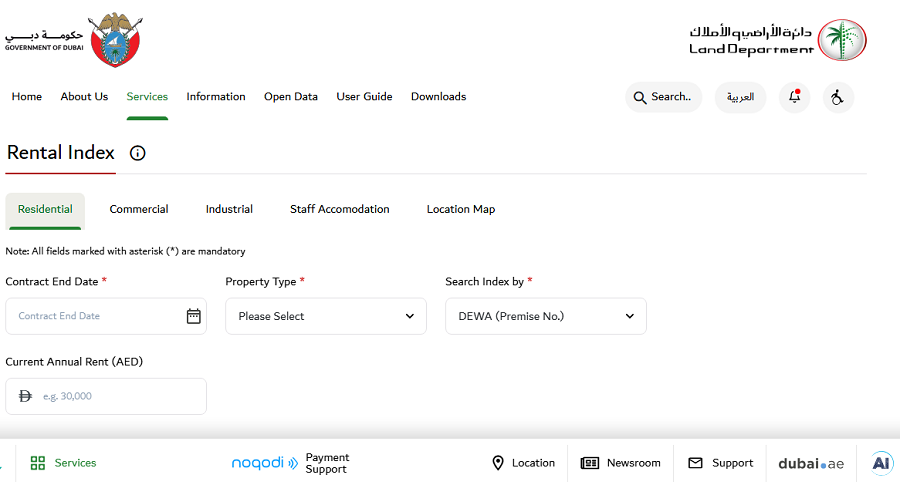
Step 1: Open the Online Tool
You can go to the Dubai Land Department website or use the Dubai REST app, which is available on both iOS and Android. Then, follow this path: Services → Rental Index.
Step 2: Enter Property Information
Now, select the property type, location, and number of bedrooms to introduce your property to the system. Also, input your current rent and contract details.
You can find your property using the “Search Index by” menu that offers multiple options:
- Area
- Ejari Contract Number
- DEWA Premise No.
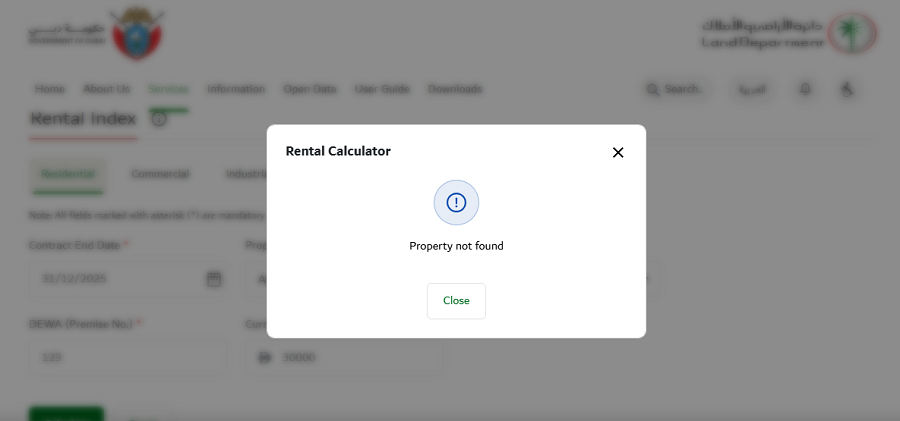
Remember that if you enter the wrong details. You might face an error like this:
Step 3: Submit for Results
Click “Calculate” to see the maximum allowable increase.
Step 4: Interpret the Results
Finally, the tool analyzes your current rent based on the market average and gives you three options:
- Below the market average
- At the market average
- Above the market average
More importantly, it also displays the maximum increase a landlord is allowed to add to the rent according to RERA guidelines.
Examples of the RERA Rental Calculator Results
Here are several calculation samples to understand how the RERA Rental Increase Calculator works:
Example 1: Apartment Slightly Below Market Average
Imagine you have rented your apartment with the following details:
- Current rent: AED 90,000/year
- Average market rent in the area: AED 100,000/year
- Gap: 10% below market
Now, the RERA calculator allows a maximum of 5% increase. So, you can consider AED 94,500/year rent for the next year.
Example 2: Villa Well Below Market Average
This time, we consider a sample like this:
- Current rent: AED 180,000/year
- Average market rent: AED 240,000/year
- Gap: 25% below market
In this case, the landlord is allowed a maximum of 15% increase, so the new rent would be AED 207,000/year.
Example 3: Apartment Above Market Average
As another sample, consider an apartment that has been rented above the market:
- Current rent: AED 120,000/year
- Average market rent: AED 100,000/year
- Gap: 20% above market
Now, the rental calculator doesn’t allow any rent increase for the next year.
Legal Context You Should Know
Dubai law requires landlords to give tenants 90 days’ notice before increasing rent. The RERA calculator becomes legally relevant in disputes: if a landlord attempts to raise rent beyond the allowed limit, tenants can refer to the calculator’s results in RERA mediation or court.
Additionally:
- Landlords cannot retroactively increase rent.
- The calculator reflects current market data, not individual property upgrades.
- Tenants can file a case at RERA if an unlawful increase is proposed.
Common Mistakes and Misconceptions
Here are some mistakes you might make about the RERA Rental Calculator:
- Wrong property type: Apartments and villas have different indices.
- Incorrect current rent: Always input the exact monthly or yearly figure.
- Misunderstanding notice periods: Rent increases must respect the 90-day rule.
- Assuming upgrades affect calculation: Renovations may justify negotiation, but do not alter RERA limits.
Being aware of these prevents disputes and ensures accurate calculations.
Tips for Tenants and Landlords
Here are some tips that help both tenants and landlords have a smooth transition from this year to the next:
Rental Best Practices for Tenants
- Check the calculator before renewal to understand your rights.
- Use the results as leverage for negotiations.
- Keep a record of RERA printouts for potential disputes.
Tips for Landlords
- Use the calculator to justify increases legally.
- Consider market conditions alongside RERA limits to maintain tenant satisfaction.
- Avoid surprises; inform tenants in writing with a 90-day notice.
Final Thoughts
Dubai’s government has a solution for every problem, especially tech-based solutions. They try to keep the city more advanced compared to other cities in the region or even in the world. With a focus on sustainability and people’s convenience, Dubai has become one of the most successful and futuristic cities we know. The RERA Rental Calculator is just a simple tool that simplifies the process of renting a property in Dubai. They have designed this software to help tenants and landlords reach an agreement without disputes and long discussions. You can easily use it to understand the rent for the next year based on your current rent and the apartment’s location and size.
FAQs
How is RERA calculated?
RERA calculates the rent increase by comparing your property’s current annual rent with the average market rent for similar properties in the same area. This is done based on lists in the Dubai Rental Index. Then, it determines if you’re allowed to increase the rent based on the gap between the two.
How to calculate the RERA index?
You don’t have to calculate the RERA index manually. You just need to check your property in the RERA Rental Calculator. It automatically compares your property rent with the average rent in the same area.
How to calculate a rental rate?
To calculate a rental rate in Dubai, you need to compare:
– Your property’s specifications (location, type, size)
– The average rent shown in the Dubai Rental Index
This gives you a realistic estimation of the market value of your property. As a rule of thumb, you can consider something between 0.9% to 1.1% of your property value for its rent.
What is the maximum rent increase for RERA?
The maximum rent increase under RERA depends on how far the current rent is below the market average.