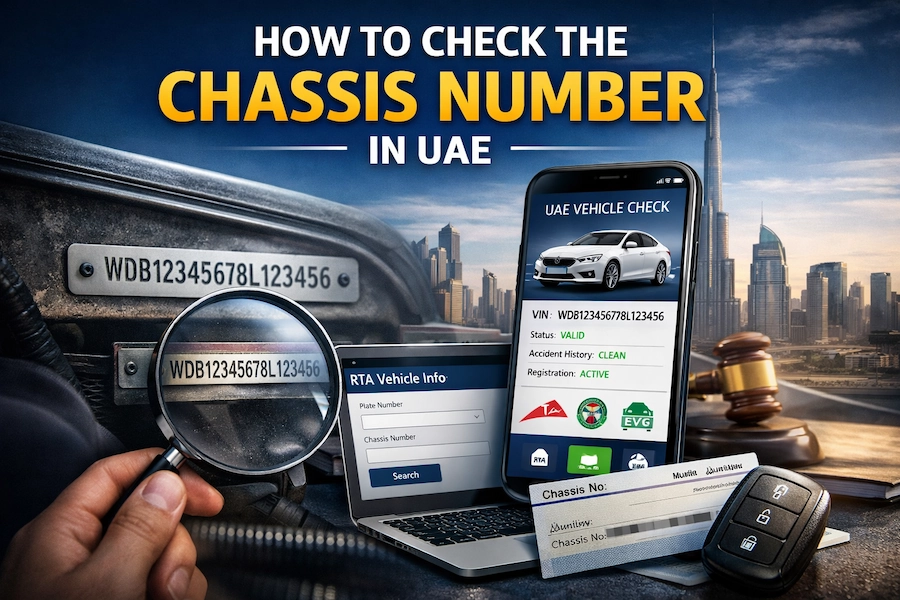
Have you ever wondered how you can verify a car’s identity or confirm its history? Fortunately, there is a global identification system for cars.
Just like the national identification number of people, cars also have a unique number as their ID.
The Chassis number is what we can use to recognize a car from other vehicles. If you’re a new car buyer, you might not be familiar with the chassis number and the way you can check it or use it.

But don’t worry. We’ve gathered all you need to know about your car’s identification and how you can check its chassis number.
What is the Chassis Number?
The chassis number is a unique 17‑character alphanumeric code for your car. It’s also known as the Vehicle Identification Number or VIN, which is a global standard to identify legal cars.
This code was introduced in 1981 by the U.S. National Highway Traffic Safety Administration (NHTSA) and accepted by other countries.

Before that, there was no unified system for vehicle identification. It’s good to take a look at the historical procedure of introducing VIN:
| Year | Chassis/VIN Development |
|---|---|
| 1907–1930s | Early unique numbers, Rolls-Royce series |
| 1954 | First standardized VIN, manufacturer-defined |
| 1966 | US 13-character VIN mandated |
| 1981 | Global 17-character VIN standardized |
So, every road‑legal vehicle in the world that has been manufactured since 1981 has a unique chassis number. In simple words, you can consider the VIN your vehicle’s DNA.
Here are some key features of chassis numbers in cars:
- It is a global standard: All cars in the world use the same VIN format.
- VIN holds key vehicle data: Using the chassis number, you can understand many useful data, like country, manufacturer, model year, engine type, and production plant.
- It is valid in legal systems: You can do all the legal and official tasks, like car registration, insurance underwriting, and police databases, using the chassis number.
In the UAE, authorities frequently use the chassis number, so you have to know your car’s VIN.
For example, the Roads and Transport Authority (RTA), Emirates Vehicle Gate (EVG), Ministry of Interior (MOI), and local police check the chassis number.
Here are some common uses of checking the VIN:
- Match your vehicle records in all systems.
- Find the accident or theft history of your car.
- Verify insurance and registration status.
- Find any possible fraud or tampering.
Where Can I Find My Car’s Chassis Number?
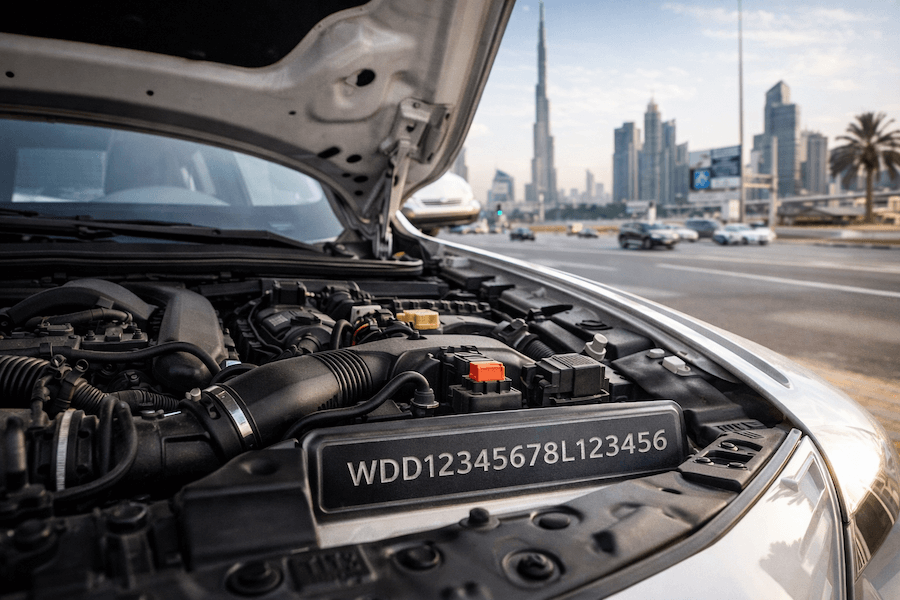
Finding your chassis number is simple if you know where to look. Manufacturers and official authorities use it on some standard documents and physical places on your car to help you find it if you forget it.
1. Physical Positions on the Vehicle
Here’s a table to help:
| Vehicle Part | Typical Location of Chassis/VIN |
|---|---|
| Dashboard | Lower left corner, visible through the windshield |
| Driver’s Door Frame | On a metal plate/sticker inside the jamb |
| Engine Bay | Stamped on the firewall or front frame |
| Under Bonnet | On top of the engine front or near the radiator support |
| Trunk Area | Under the spare tyre or floor panel (less common) |
If any of these plates look scratched, faded, replaced, or altered, something may be wrong with the car. So, always try to inspect all available locations.
2. Documents with the Chassis Number
Your UAE vehicle documents are key places to cross‑verify the chassis number. Here are the most important documents to find and check the VIN of your car:
- Vehicle Registration Card (Mulkiya): It usually shows the VIN clearly.
- Insurance Policy: Insurers list the VIN to match coverage to the exact car.
- Service and Maintenance Records: It often includes the VIN for identification.
- Purchase Invoice: Without the VIN, the invoice may be invalid.
- Export or Import Papers: If the car came from abroad.
Always check that the VIN on the car, the Mulkiya, and all documents match exactly. Remember that even if one digit is off, it could be a red flag.
Understanding the VIN Structure
The entire VIN is important, but many people mistake just the last series of digits for the chassis number.
The reason is that in the past, only the last six characters of the VIN were used as the chassis number. Today, most UAE systems treat the full 17‑digit VIN as the chassis or vehicle ID.
Here is the structure of a VIN:
| Digits | Meaning |
|---|---|
| 1–3 | World Manufacturer Identifier |
| 4–8 | Vehicle attributes (model, body type, engine, etc.) |
| 9 | Check Digit (used to validate authenticity) |
| 10 | Model year |
| 11 | Assembly plant |
| 12–17 | Unique serial number (core of the chassis ID) |
The “check digit” is a checkpoint that helps detect fake or incorrect VINs. If the VIN fails this check, systems may automatically flag it as invalid.
When You Need the VIN in the UAE
Let’s understand how chassis checks help you in real situations:
1. Buying a Used Car
Verifying the VIN reveals real history, including accident records, theft flags, or mismatches with paperwork, before you make a purchase.
2. Imported Vehicles
Imported cars may not appear in UAE history systems if they have no local record. In such cases, online global VIN decoders help confirm manufacturer details, but you still need local checks for UAE‑specific history.
3. Discrepancies & Tampering
If the VIN on the car differs from the Mulkiya, that strongly suggests fraud or tampering. You should halt the sale and involve the authorities.
4. Legal and Insurance Compliance
Mismatch in VIN and documents can lead to insurance rejection or registration delays, so always verify before renewing insurance or ownership transfer.
How to Check Chassis Number and Verify Online in the UAE
Now, let’s see how you can verify your chassis number using official UAE online services. This is especially useful when buying a used car. Here is a step-by-step guide:
- Locate the VIN from your car or documentation
- Choose the right UAE portal based on your emirate
- Enter the VIN exactly with no spaces. Remember that it’s case sensitive
- Review all available information
- Cross‑check it with your physical VIN and documents
The following table lists the portals where you can check the VIN:
| Portal | Information | Best For |
|---|---|---|
| Emirates Vehicle Gate (EVG) | Accident history & basic record (not Dubai) | Used cars outside Dubai |
| Ministry of Interior (MOI) | Accident & theft records nationwide | Comprehensive flag checks |
| RTA Dubai Vehicle Services | Registration & accident info (paid reports too) | Dubai‑registered vehicles |
| Abu Dhabi Police | Accident & theft check | Abu Dhabi region |
| Tasjeel Centres | In‑person full reports (paid) | Deep technical and inspection history |
Basic checks like accident history are typically free on government sites. For full reports, like on ownership changes, mileage history, export status, and technical inspection, you need to pay for an official certificate.
Try to consider the following tips when checking your VIN:
- Always use official government websites or apps: Third‑party “free VIN lookup” sites might be useful, but they often do not connect to UAE government systems.
- Perform checks on more than one portal: EVG covers some emirates, MOI covers others, RTA covers Dubai.
- If you didn’t find the VIN online, you have to question the authenticity or try alternative methods. It’s also good to recheck your documentation.
Final Thoughts
Before buying a car in the UAE, you have to check its documents to make sure there is no mismatch. You can check the chassis number of the car to see all the information, like the country, manufacturer, model year, engine type, and production plant. This is the best way to match the vehicle records on all official systems. So, apart from finding verified cars for buying from valid sources like Shozon, you have to personally check the VIN.
FAQs
How to check a car chassis number online?
Use official UAE portals like RTA Dubai, MOI, or Emirates Vehicle Gate (EVG) by entering the plate number or VIN.
How to check vehicle details in the UAE?
Enter the plate number or chassis number on RTA, MOI, or Abu Dhabi Police portals to view vehicle details.
How to check details using a chassis number?
Input the 17-character chassis number (VIN) on official portals to see registration, accident, and ownership-related data.
Is it free to check a chassis number?
Yes, basic checks are free, but detailed reports (full history, inspections) may require a small fee.
How to trace a chassis number in the UAE?
Use MOI or police portals to trace accident or theft records linked to the chassis number.