Loading...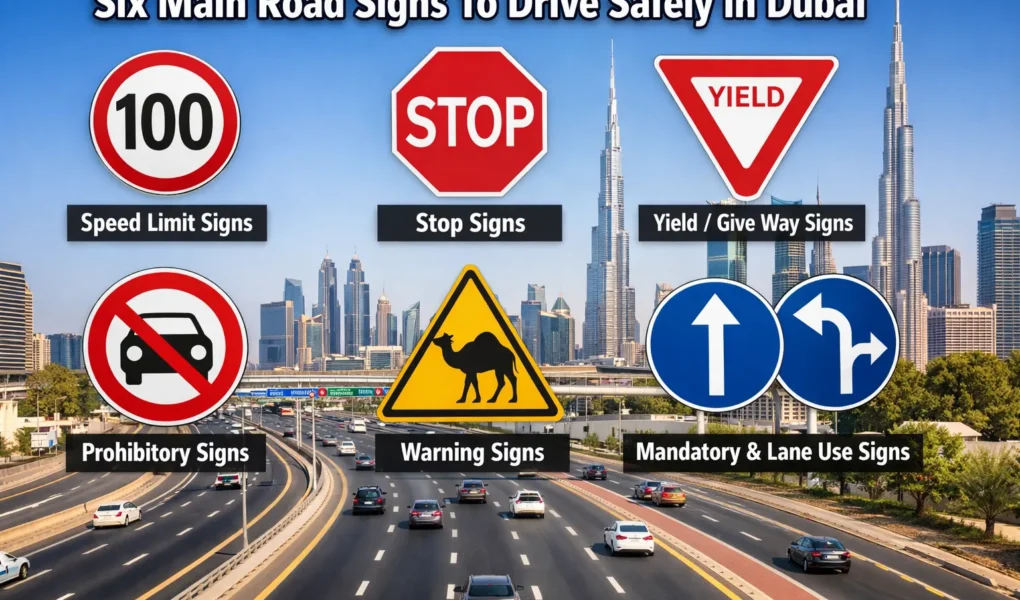
Have you ever thought why the roads in Dubai are this neat, in spite of millions of cars passing through every day?
Dubai road signs are essential in road safety. In a move to reduce accidents and ensure drivers are guided by traffic signs, the Roads and Transport Authority (RTA) of Dubai has placed more than 210,000 traffic signs as of 2025. Such signs which are well positioned in strategic places on highways and streets are used to ensure order and reduce confusion.
According to experts, traffic signs are “essential to protect drivers and other road users from accidents” because everybody is aware of the rules. There are bilingual (Arabic and English) signs with clear symbols, which are indicative of the strict rules of road traffic and the high level of infrastructure in Dubai.

In this article, we’ll explain six key road-sign categories that every driver in Dubai must recognize to drive safely.
Why All Drivers Must Clearly Understand Essential Road Signs?
Every driver, long-term residents, newcomers, and tourists should be aware of road signs in Dubai.
First, safety: signs remind about dangerous conditions, regulate traffic to ensure that no one is involved in accidents.
Second, legal compliance: Dubai is a strict enforcer of the traffic rules. Not stopping at a sign or reading a speed limit wrongly may result in a fine or points of the license. When a driving test is to be taken as an example, not seeing a stop sign or a yield sign results in failure.
Lastly, navigation: Dubai has extensive high-speed roads; knowledge of road signs (written both in English and Arabic) will enable a motorist to navigate comfortably. Simply, road sign knowledge prevents confusion, fines and accidents.
Categories of Road Signs in Dubai
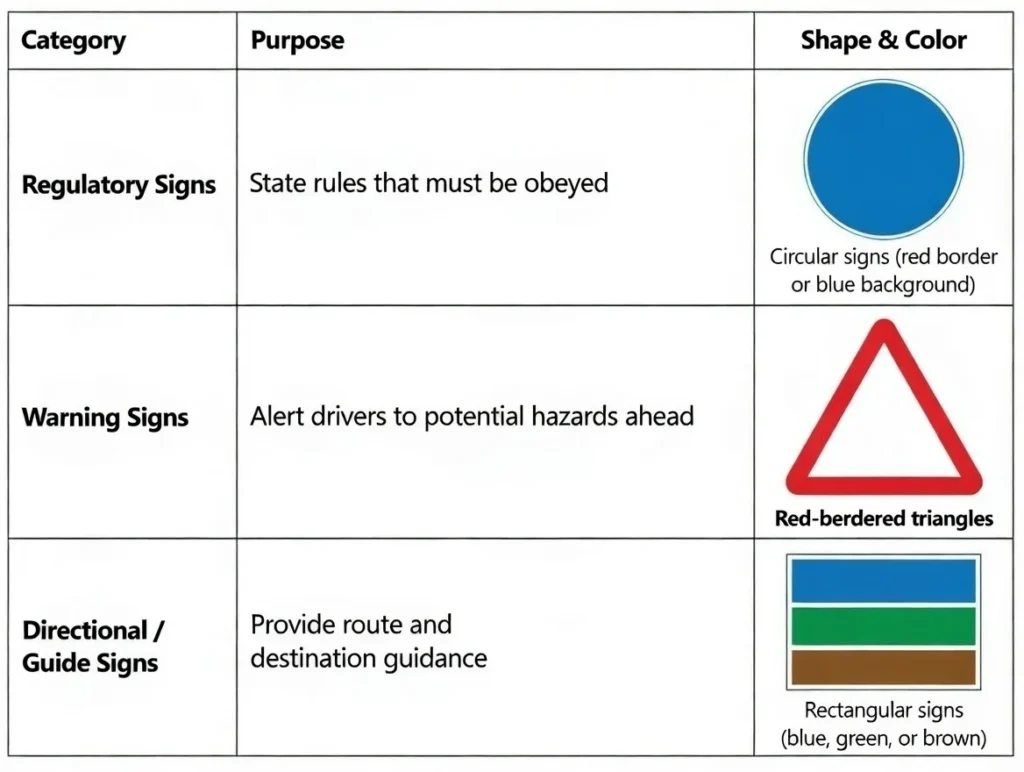
| Category | Purpose | Shape & Color |
| Regulatory Signs | State rules that must be obeyed | Circular signs (red border or blue background) |
| Warning Signs | Alert drivers to potential hazards ahead | Red-bordered triangles |
| Directional / Guide Signs | Provide route and destination guidance | Rectangular signs (blue, green, or brown) |
The road signs in Dubai are categorised neatly based on shape and colour. The RTA divides them into three broad categories:
Directional/Guide signs, Regulatory (rules to follow), and Warning signs.
Regulatory signs include control, prohibitory, and mandatory signs, and inform drivers on what they should or should not do.
There are warning signs (red-bordered triangles) that indicate a curve or crossing or other danger in the road ahead of you.
Directional/ Guide signs (usually blue or green rectangles) these signs aid you in locating your destinations or major routes.
In Dubai, the purpose of a sign is easily determined by its shape and color: circular and red-bordered signs indicate that an action is forbidden, blue-circled are required, and red–triangle signs indicate danger.
Guide signs have a color-code too: blue guide signs indicate federal highways that link emirates, green guide signs local roads within Dubai, and brown guide signs the tourist attractions.
Six Main Road Signs To Drive Safely in Dubai
Here are the six major types of signs that all Dubai drivers need to know. The shape, color and meaning of each of these signs has been explained and where you will see the sign and why it is important to your safety.
Speed limit signs
Speed limit signs The Dubai speed limit signs are white circles with a red border and a number (written both in Arabic and English) in the center. They show the maximum allowed speed in that road.
E.g. an indicator denoting 60 (٦٠) indicates that you are not allowed to exceed 60 km/h. Such signs are displayed in the beginning of the speed zones (e.g. urban streets, highways, school zones) and are reiterated as necessary.
Compliance with the posted speed limits is an essential requirement: it helps to ensure traffic flow and avoid accidents.
Speed limits are enforced strictly in Dubai (even in many cases with a 20 km/h buffer), and, therefore, adherence to these signs prevents significant fines as well.
Stop signs
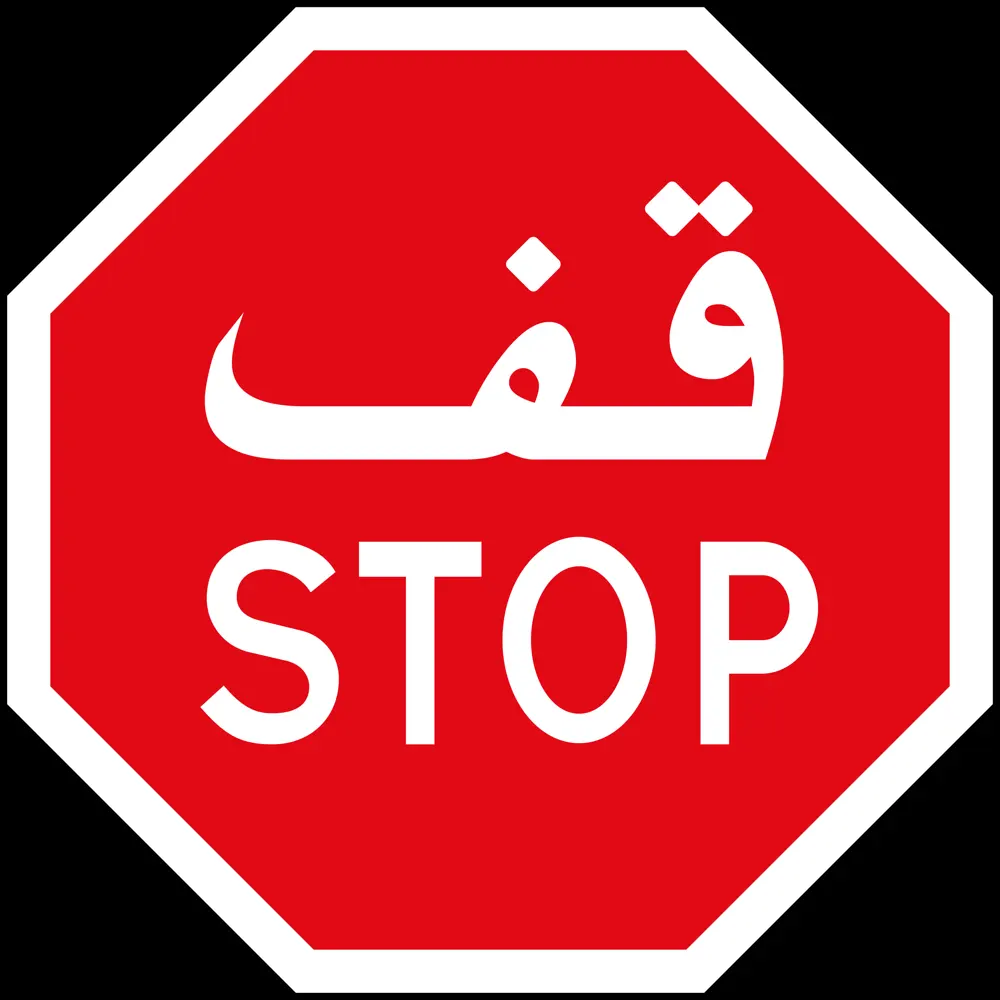
The red octagonal sign with the word STOP (قف in Arabic) in white is known as the Stop sign in Dubai. In case of occurrence of this sign at a crossroad, then you should stop your transport and ensure you give way to the other traffic and pedestrians.
When you come across this mark at a crossroad, you have to stop your car and yield to other traffic and pedestrians.
Once you have stopped, then you only move forward when there is a clear path. This law avoids junction collisions.
It is also a grave offence to disregard a stop sign in Dubai (e.g. roll through without a complete stop) as it can incur heavy fines and black points. Stopping completely even when there is no moving cross-traffic is crucial to the safety.
Yield / Give Way signs
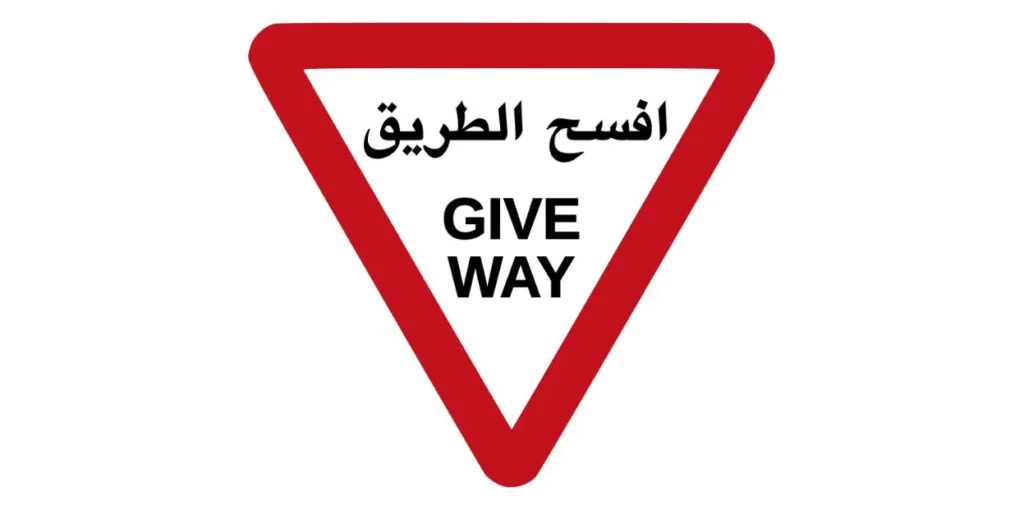
Yield / Give Way signs The ‘Give Way’ sign (also called Yield) is an inverted triangle that has a red border. It informs drivers to drive slowly and to be ready to stop and yield to the crossing traffic or pedestrians.
There is no need to always completely stop at a yield sign like at the stop sign, unless there are other vehicles or pedestrians approaching you. The yield signs are commonly located in the roundabouts or minor crosses.
The meaning of this sign will make you know when to give way to others. The lack of a yield sign may cause side-collision accidents. Briefly, a red triangle Give Way sign entails allowing other people to pass first.
Prohibitory signs
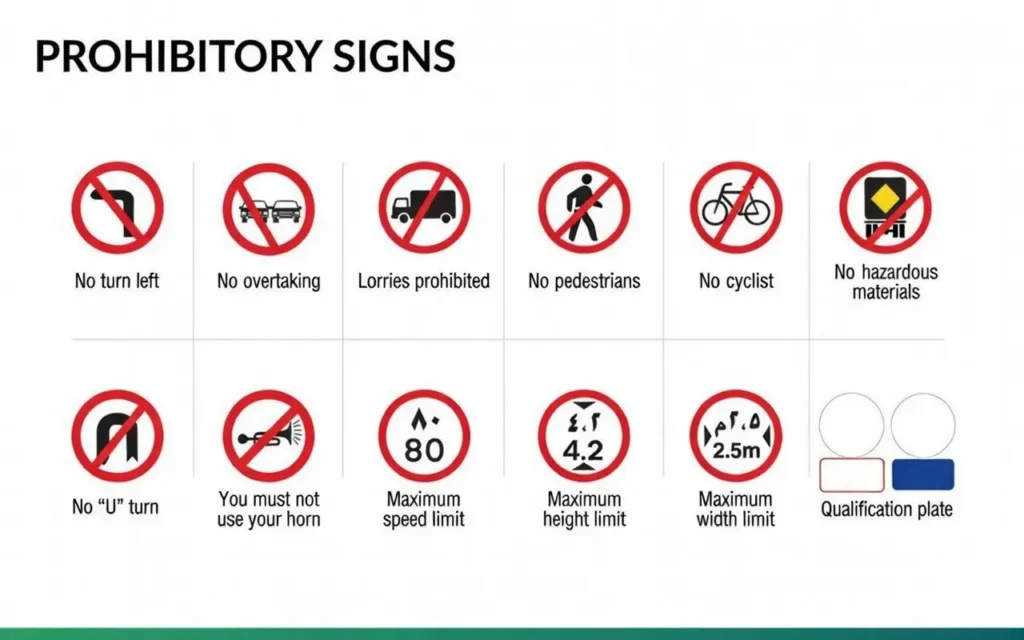
Prohibitory signs use circular shapes with red borders to prohibit specific actions. Examples of common ones are “No U-turn”, “No Left Turn”, “No Overtaking”, “No Entry”, and “No Horn” signs.
The pictogram within (usually black with red slash) shows what is prohibited. An example of this is a No U-turn sign, which shows that you cannot U-turn there and No Overtaking sign, which does not allow passing of other vehicles. These signs play a major role in safety.
Traffic experts emphasize that prohibitory signs “restrict certain actions to maintain road safety,” so obeying them avoids accidents. Disregarding a prohibitory sign (like making an illegal turn) can cause crashes and carries penalties.
Warning signs
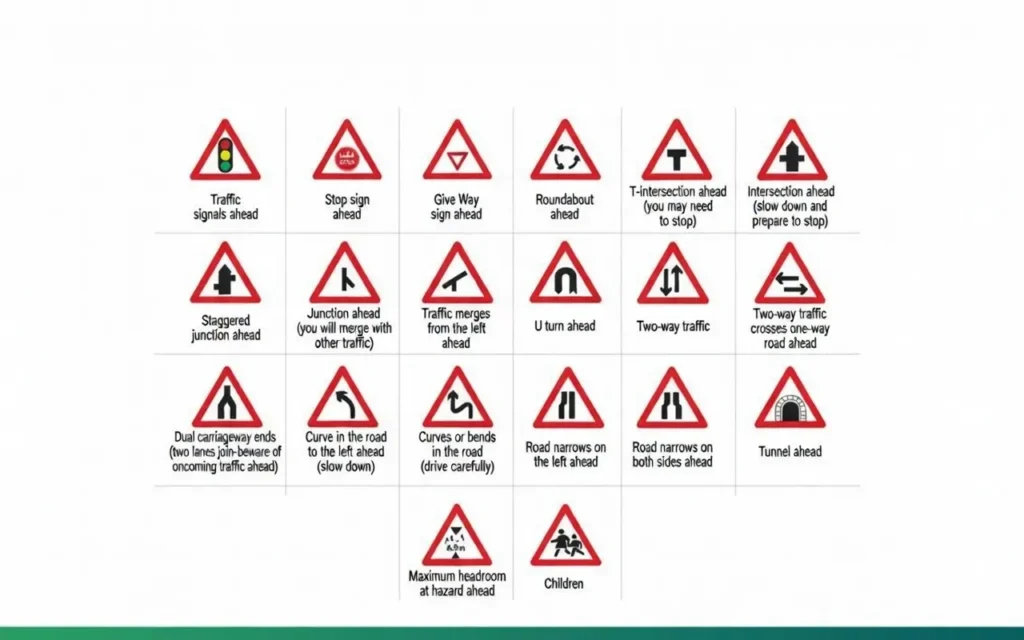
The warning signs in the UAE are typically triangles that have a red border. They caution you against dangers or reformations in the future.
An example is a triangular sign with a curve arrow that means to “bend ahead” and a triangular sign with bumped icon, which means to “speed bump ahead”.
These signs comprise of clear symbols on white background. When you encounter one, then you need to slow down and drive more carefully.
The following shapes are important to learn: Red- triangle signs indicate that there is danger ahead and one should be aware. Taking heed of warning signs (by adjusting speed or steering) helps drivers prepare and avoid emergencies.
Mandatory direction and lane use signs
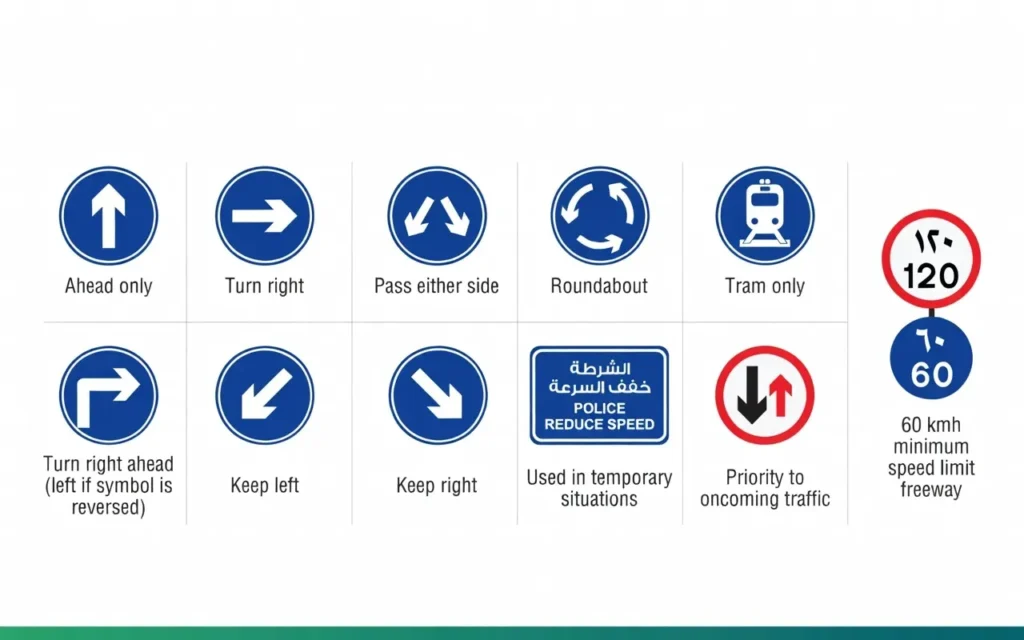
Mandatory signs are blue circles (or blue rectangles in lane markings) that instruct drivers on what they must do.
An example of this is the blue circle and white right turn arrow which indicates the message to turn right only. Others can be straight ahead only, keep left, or lane arrows. Such signs are usually at crossways, roundabouts or lanes merging. They guarantee movement of traffic in the right direction.
According to the Trinity driving guide, there are mandatory signs (blue circles) that show what you are required to do on the road. Through the obligatory signs, vehicles remain in the correct lanes and avoid confusion.
Overlooking them (such as driving in a straight line in a right-turn only lane) may lead to accidents or jams. In brief, there are blue mandatory signs that give simple instructions to follow, and it is a legal obligation to follow them in order to drive smoothly and safely.
Practical Tips for Using These Signs to Stay Safe in Dubai
The following are practical tips that can assist residents and tourists as well as new drivers use road signs and drive safely in Dubai.
Scan far ahead and anticipate changes
Always scan 100-200 meters in advance, particularly in front of exits, intersection and roundabouts. Early awareness gives you sufficient time to change lanes or adjust the speed.
Strictly follow speed limits at all times
There are numerous speed radars in Dubai. Adjust your speed at the entrance point to the new speed limit, do not use braking at the end moment before the cameras.
Make full stops and yield correctly
At Stop signs, come to a complete halt — no creeping forward. At Give Way signs, especially at roundabouts, slow down properly and allow traffic with priority to pass before merging.
When you are at Stop signs, stop and do not creep on. When there is a Give Way sign, particularly at the roundabouts, slowdown in proper order and give traffic with priority to pass before merging.
Obey prohibitory signs without exception
“No U-Turn,” “No Entry,” or “No Overtaking” are strictly enforced. The neglect of them may lead to immediate fines and black points.
Slow down early when you see warning signs
When it is raining, foggy or the road is experiencing heat haze, slow down further before going into curves, pedestrian crossing, or road work. It is better to prevent than to cure.
Follow mandatory arrows and lane markings precisely
At multi-lane roads and at complex junctions, make an early move to the right lane. Use arrow direction and do not make last minute lane change.
Drive defensively at all times
Always use your mirrors, use signals before switching lanes or taking turns and always keep a safe distance in front of you so that you can have time to react.
Common Mistakes Drivers Make with Road Signs in Dubai
The most frequent driving mistakes and their ways of correction are critical to the safety, compliance, and assurance on the road. These mistakes are described below, why they are especially risky in Dubai, and how drivers should behave instead.
Ignoring or Misreading Road Signs
Misreading or Ignoring Road Signs includes things like neglecting a Stop or Yield sign, passing over alterations in a speed limit or even not noticing warning signs in the road.
Highways and interchanges in Dubai are multilane, and one has to be aware all the time. The absence of a sign may lead to fines, black points, failure in the tests, and even collisions.
Drivers need to be proactive and scan the road before them in all times, predict road signs before crossroad, turnaround and speed limit zones and be mentally alert particularly in the busy roads.
Not Coming to a Full Stop
Not Coming to a Full Stop can be defined as rolling past the red lights or Stop signs without completely stopping the vehicle. There are those drivers who put on their brakes late or creep along. Partial stops promote side impact and pedestrian accidents.
It is viewed as a high-level of traffic violation and can lead to a direct failure of driving tests. At Stoplights and red lights drivers must stop the vehicle taking at least two seconds to ensure full stop before continuing.
Speeding
Speeding refers to driving faster than the stipulated maximum speed (km/h) even slightly higher than the speed limit. Dubai has strict regulations of speed using advanced monitoring mechanisms.
Even minor speeding breaches attract fines and black points and an increase in speed decreases the reaction time. The drivers are expected to keep on checking the speed limit signs and change the speed as soon as they enter a new zone particularly near residential neighborhoods, school areas, or construction areas.
Failing to Yield
Failing to Yield happens when drivers fail to yield to pedestrians or yield at a crossing or even at a roundabout or a junction. Violation of the rules of right-of-way enhances the chances of accidents, especially on high-traffic crossings and pedestrian crossings.
Drivers must also always give way to pedestrians at any marked crosswalks and where there are roundabouts and yield signs they have to give way to the approaching vehicles that are already in motion but watch out on any sudden movement of pedestrians.
Tailgating
Tailgating is defined as driving too closely behind another vehicle without having to maintain a safe distance. Rear-end collisions can be as a result of sudden braking in the traffic of Dubai. Tailgating is against the law and results in penalties.
The minimum following distance should be three seconds and the distance should be increased during heavy traffic or adverse weather conditions to create adequate braking distance.
Conclusion
Safe driving is based on clear understanding of the road signs in Dubai. These indications maintain road sanity, ensure that no one is at a disadvantage on the road, and avoid accidents.
You are now ready to drive safely on the roads, so you need to ensure that you have a right car to drive. Visit Shozon.com to get trusted vehicles to sell in Dubai and begin your journeys with a lot of confidence.
Be aware of the traffic laws, drive, and use these signage guidelines to be safe on the road and to protect other people. Explore Shozon to find more traveling and driving information.
In the UAE, blue-colored signs typically indicate mandatory instructions or guidance. Circular blue signs tell you what you must do (for example, a blue circle with an arrow means “turn that way”).
Larger blue rectangular signs are often guide signs on highways (e.g. pointing to major routes between emirates).
The Stop sign is an octagonal red sign requiring drivers to come to a complete stop at the marked line, then proceed only when safe.
The Give Way (Yield) sign is a downward-pointing red triangle. It means you must slow down and yield to other road users (vehicles or pedestrians) before continuing, but you don’t always have to stop if the way is clear.
In summary: Stop = full stop mandatory; Give Way = slow and let others go first.
Yes. All regulatory and warning signs in Dubai use international symbols and include both Arabic and English text. This bilingual approach helps both locals and foreign drivers understand the signs.
Ignoring a No U-turn sign is a traffic offense in Dubai. Dubai Police enforce it with heavy penalties. For example, motorists making illegal U-turns have been fined AED 500 and given 4 black points on their license.
The Roads and Transport Authority (RTA) provides the official guidelines. The Dubai Traffic Control Devices Manual contains detailed standards for all road signs (shapes, colors, meanings).
You can find this and other resources on the RTA website. Local driving institutes and reputable driving guides (like the RTA’s official materials or trusted driving schools) also offer comprehensive tutorials on UAE road signs.