
Rental yield in Dubai depends on how much rent a property can realistically collect relative to what it costs to buy. In H1 2026, Dubai apartments averaged a 6.9% gross rental yield, while villas and townhouses averaged 5.0%, according to Cavendish Maxwell. Net yields are lower once service charges, maintenance, vacancy and acquisition costs are deducted: in the worked example below, an 8.25% gross yield falls to 5.61% net on total acquisition cost.
For a 2026 purchase, compare dated market benchmarks with the actual property’s achievable rent, verified costs, and likely vacancy.
Average Rental Yield in Dubai by Property Type
The average rental yield in Dubai should be read alongside its reporting period and property category. A citywide apartment average is not interchangeable with a villa average or the projected return on a particular studio.
According to Cavendish Maxwell’s Dubai Residential Market Performance report for H1 2026, gross apartment yields averaged 6.9%, while villas and townhouses combined averaged 5.0%. These are first-half benchmarks, before individual ownership costs.
| Property category | Reported gross yield | Period | How to use it |
| Apartments | 6.9% | H1 2026 | Benchmark an apartment against comparable units and its own costs |
| Villas and townhouses combined | 5.0% | H1 2026 | Compare within the relevant community and property type |
Do not average these two percentages to create an overall Dubai figure. That would require the appropriate underlying sample and weighting methodology.
Why Rental Yield Figures Differ Between Reports
Two reports can produce different results because they use different:
- Months or quarters.
- Asking prices or registered sale prices.
- New leases, renewals or advertised rents.
- Property sizes and community boundaries.
- Average, median or weighted calculations.
For example, Engel & Völkers reported an average gross residential yield of 6.6% in June 2026, with apartments at 6.9%, townhouses at 5.1% and villas at 4.5%. Reports on Q2 2026 rents also diverged: Cushman & Wakefield Core and CBRE recorded quarterly declines of around 6%, while ValuStrat described rents as largely stable during the quarter.
Record the methodology and refresh property-specific rent and price evidence before making an offer.
How Q2 2026 Rent and Price Changes Affect Yield
Cushman & Wakefield Core’s H1 2026 Dubai Mid-Year Market Update reported that citywide residential rents fell 6% and sale prices fell 4% quarter-on-quarter in Q2 2026. These citywide averages do not describe every property in Dubai.
Test lower rent in your forecast. Yield can change even when rents and prices move in the same direction.
What Rental Yield Measures and How It Differs from ROI
Rental yield measures annual rental income relative to a stated property cost or value. It is useful for comparing income potential, but does not by itself measure the complete investment result.

1. Gross rental yield: Before Ownership Costs
Gross rental yield uses rent before operating expenses:
Gross rental yield = annual rent ÷ purchase price × 100.
This calculation assumes the full scheduled rent is received.
2. Net rental yield: After Operating Expenses
Net rental yield deducts the relevant ownership and letting expenses. State whether the denominator is the purchase price, total acquisition cost, or current market value.
Use the same cost basis and expense categories when comparing properties.
| Measure | What it answers |
| Gross yield | How much scheduled rent does the purchase price support? |
| Net operating yield | What remains after property operating costs? |
| Cash flow after finance | What cash remains after mortgage payments? |
| Cash-on-cash return | What annual cash return does the owner’s cash investment generate? |
| Total ROI | What is the overall result across income, costs, and disposal? |
The phrase “average ROI” is sometimes used loosely for rental yield. A full ROI calculation needs a defined holding period and additional inputs, including the eventual sale outcome.
Highest Rental Yield Areas in Dubai: Compare Communities and Buildings
The highest rental yield areas in Dubai are useful starting points for a shortlist. Community averages still need to be tested against the actual purchase price, tenancy, service charges, and condition of each unit.
Engel & Völkers data from August 2026 places Dubai Investments Park and International City among the highest-yielding apartment areas in Dubai, while prime waterfront and central areas record lower gross yields. These are dated gross benchmarks, not promises of net income.
| Area | Approx. gross apartment yield |
| Dubai Investments Park | 9.61% |
| International City | 8.89% |
| Dubai Production City | 8.18% |
| Dubai Marina | 5.64% |
| Downtown Dubai | 5.21% |
| Palm Jumeirah | 4.66% |
Source: Engel & Völkers, August 2026.
1. Dubai Investments Park: Verify the Lease and Building Costs
Investigate the exact residential development, unit type, and ownership arrangements. Check access to employment locations, the condition of shared facilities, and the supply of similar apartments available to tenants.
Request the current lease, if occupied, and establish whether the advertised return uses that lease or a higher projected rent. A community-level percentage cannot resolve this difference.
2. International City: Check the Cluster and Maintenance
Examine the specific cluster and building. Compare similarly sized units, inspect maintenance quality, and establish the approved ownership costs.
Check parking, surrounding services, and the apartment’s condition before accepting a rent assumption. A low purchase price does not compensate automatically for recurring repairs or difficult tenant turnover.
Compare Other Dubai Communities at Building Level
Comparing Dubai investment areas requires matched property types, recent rent evidence, and realistic ownership costs.
| Community | Checks Before Buying |
| Dubai Sports City | Compare unit sizes, building condition, service charges and competing rental stock |
| Dubai Silicon Oasis | Match buildings and agreed rents, then check access to tenant destinations |
| Jumeirah Village Circle | Compare older and newly delivered stock, letting competition and management quality |
| Discovery Gardens and Al Furjan | Assess price against achievable rent, transport access and running costs |
| Arjan | Compare layouts, nearby construction and initial rent assumptions |
| Dubai South | Separate existing demand from projections, then check services, commutes and handovers |
| JLT, Business Bay and Dubai Marina | Test the purchase premium against building fees, vacancy and achievable rent |
Identify the likely tenant and test demand against comparable rental agreements.
The highest rental yield in Dubai for your budget may come from a well-priced individual unit, even when its community does not top a published table.
How to Calculate Rental Yield in Dubai: A Complete Example
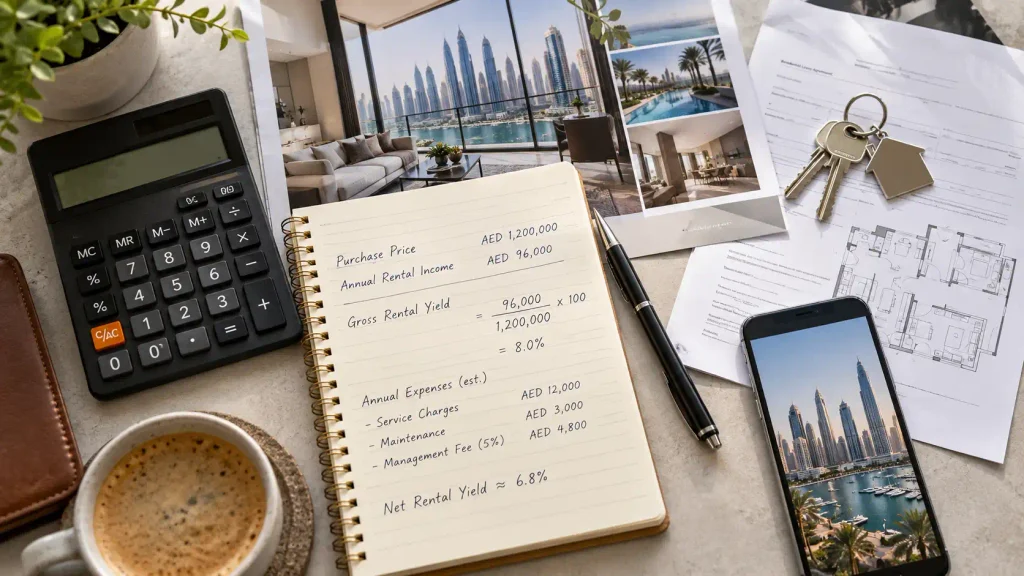
To understand how to calculate rental yield in Dubai, separate scheduled rent, collected rent, operating expenses, and capital invested.
This hypothetical example uses illustrative prices, costs and vacancy assumptions.
1. Establish the Acquisition Cost
| Item | Assumed amount |
| Purchase price | AED 800,000 |
| Acquisition and initial setup costs | AED 56,000 |
| Total acquisition cost | AED 856,000 |
The AED 56,000 is illustrative. Itemise registration, transaction fees, agreed commission, and initial works using actual quotations.
2. Calculate Scheduled Gross Yield
Assume annual contractual rent of AED 66,000:
AED 66,000 ÷ AED 800,000 × 100 = 8.25%.
Use contractual annual rent. Multiply a monthly figure by twelve only if it represents the same letting arrangement.
3. Calculate Net Income After Vacancy and Operating Costs
| Annual income or expense | Assumed amount |
| Scheduled rent | AED 66,000 |
| One month of vacancy | −AED 5,500 |
| Rent after vacancy | AED 60,500 |
| Service charges | −AED 8,000 |
| Management and letting allowance | −AED 2,000 |
| Maintenance allowance | −AED 1,500 |
| Insurance and other owner-paid costs | −AED 1,000 |
| Net operating income | AED 48,000 |
These allowances are fixed for illustration. Apply the actual management contract if fees depend on collected rent.
4. Compare Net Yield on Purchase Price and Total Acquisition Cost
Net yield on purchase price = AED 48,000 ÷ AED 800,000 × 100 = 6.00%.
Net yield on total acquisition cost = AED 48,000 ÷ AED 856,000 × 100 = 5.61%.
Both results exclude mortgage payments and any applicable owner taxes. An 8.25% headline yield therefore does not represent an 8.25% annual cash return.
Do not subtract vacancy twice. Here it has already reduced rent to AED 60,500 before operating costs are deducted.
Dubai Ownership Costs That Reduce Rental Returns

Some costs recur annually. Others arise when you buy, furnish, or sell. Their treatment changes the calculation.
1. Annual Service Charges, Maintenance and Letting Expenses
Include costs the owner actually bears:
- Approved service charges.
- Repairs and routine maintenance.
- Management and tenant-search expenses.
- Insurance.
- Owner-paid utilities or cooling charges.
- Furniture and appliance replacement provisions where relevant.
- Tenant turnover costs and rental concessions.
Dubai Land Department (DLD)’s Service Charge Index identifies approved project fees. The applicable project, property use, and year must match the unit, and the figures should be checked against invoices and the chargeable area.
The worked example assumes AED 8,000 a year, equal to AED 10 per square foot on an 800-square-foot chargeable area. At AED 15 per square foot, the same unit would pay AED 12,000; at AED 22, it would pay AED 17,600. Any increase comes directly out of net income if all other assumptions remain unchanged.
Check every charge component and avoid duplicating costs already covered by an invoice or management quotation.
2. Upfront Registration, Transaction and Setup Costs
DLD’s sale registration schedule lists 2% registration charges for each of the buyer and seller, plus other applicable fees. Establish the contractual allocation and obtain a complete transaction quotation.
Include the purchaser’s actual acquisition expenses in the total-cost denominator. A one-off registration charge should not also appear as a recurring annual operating deduction.
Refundable tenant deposits are liabilities, not rental profit. Record initial furnishing costs separately from provisions for future replacements, without deducting the same expenditure twice.
Why a Lower Gross Yield Can Deliver Better Net Income
Compare properties using the same annual period and expense categories. This hypothetical example assumes full occupancy for both properties to isolate operating costs.
| Comparison | Property A | Property B |
| Purchase price | AED 900,000 | AED 1,000,000 |
| Total acquisition cost | AED 960,000 | AED 1,065,000 |
| Annual rent | AED 81,000 | AED 85,000 |
| Gross yield | 9.00% | 8.50% |
| Annual operating costs | AED 30,000 | AED 18,000 |
| Net operating income | AED 51,000 | AED 67,000 |
| Net yield on total acquisition cost | 5.31% | 6.29% |
Property B requires more capital but produces more net income and a higher net yield under these assumptions. Financing, vacancy, condition, and resale prospects still need separate examination.
What Is a Good Rental Yield for Your Investment?
A useful target relates to your income needs, liquidity, financing, and alternatives. There is no single percentage that makes every Dubai property attractive.
1. Calculate a Purchase-Price Ceiling from Your Target Yield
Suppose reliable evidence supports AED 48,000 of annual net operating income and your required net yield on total acquisition cost is 6%:
Maximum total acquisition budget = AED 48,000 ÷ 0.06 = AED 800,000.
If acquisition and setup costs at the contemplated deal are AED 50,000, the purchase-price ceiling would be approximately AED 750,000. Recalculate costs when the price changes because some fees are proportional.
This establishes an income-based price ceiling. A property valuation assesses market value using comparable evidence; neither calculation guarantees future income.
2. Compare Yield on Purchase Cost with Yield on Current Value
Distinguish yield on your original purchase cost from yield on current value. If the property rises in value while rent stays unchanged, its current-value yield falls even though the income return on your historical cost is unchanged.
Use purchase-cost yield to assess the deal you are entering and current-value yield when reviewing whether to continue holding an existing property.
Stress-Test Rent, Vacancy and Mortgage Payments
The table below reworks the AED 856,000 example under less favourable conditions. Annual operating costs stay at AED 12,500 in every scenario, so only rent and vacancy change.
| Scenario | Scheduled annual rent | Vacancy | Net operating income | Net yield on total cost |
| Base assumptions | AED 66,000 | One month | AED 48,000 | 5.61% |
| Rent falls 10% | AED 59,400 | One month | AED 41,950 | 4.90% |
| Slower letting | AED 66,000 | Two months | AED 42,500 | 4.96% |
| Both changes | AED 59,400 | Two months | AED 37,000 | 4.32% |
These are scenarios, not forecasts. Actual variable expenses may also change with income.
1. Calculate Cash Flow After Mortgage Payments
If annual mortgage payments are AED 42,000, the base case leaves AED 6,000 before tax. The combined downside case produces an AED 5,000 cash shortfall.
Cash flow after finance includes the full mortgage payment, including principal. Principal repayment affects the owner’s equity, but cannot be spent as rental cash.
2. Compare Higher Rent with the Cost of Waiting for a Tenant
Over the same twelve-month window, a hypothetical AED 72,000 annual rent collected for ten months produces AED 60,000. An AED 68,000 lease starting immediately produces AED 68,000 before costs.
This comparison illustrates the cost of waiting for a higher rent. Assess tenant quality and contractual terms alongside the amount.
Long-Term vs Short-Term Rentals: Compare Annual Net Income
Annual leases and holiday letting have different cost structures. Use the same property cost and annual comparison period for both.
| Input | Annual lease | Holiday letting |
| Revenue basis | Contract rent and expected collection | Nightly rates multiplied by occupied nights |
| Vacancy assumption | Gaps between tenants | Occupancy across the entire year |
| Utilities | Check contractual responsibility | Include owner or operator costs |
| Additional expenses | Letting and tenancy management | Platform fees, cleaning, linen, furnishing and guest support |
| Management comparison | Actual agreed scope and fees | Actual operating scope and fees |
Dubai DET’s holiday-home permit process applies to residential units operating as holiday homes. Verify the required approvals and the building’s applicable rules before using this strategy in your forecast.
A hypothetical average nightly rate of AED 450 at 65% occupancy produces approximately AED 106,763 gross annually. It excludes operating expenses and assumes a constant average rate across occupied nights.
Model seasonal rates and occupancy, then deduct complete costs. Compare both letting models using annual net income after their respective operating costs.

Rental Yield vs Capital Appreciation: Measure Both Separately
Rental yield vs capital appreciation is a comparison between annual income and changes in asset value. Neither outcome guarantees the other.
Assess resale potential independently of rental income. Neither a high nor a low yield establishes whether the property will appreciate.
For a hypothetical cash purchase:
- Total acquisition cost: AED 856,000.
- Net rental income over three years: AED 144,000.
- Sale proceeds after selling costs: AED 900,000.
- Overall profit: AED 144,000 + AED 900,000 − AED 856,000 = AED 188,000.
- Simple cumulative ROI: AED 188,000 ÷ AED 856,000 × 100 = 21.96%.
That is a three-year cumulative return, not an annual yield or an annualised return. The calculation excludes financing and tax, and the sale price is an assumption.
For more complex cash flows, assess timing through an appropriate annualised measure rather than simply dividing total ROI by the number of years.
Verify Rent, Tenancy and Building Costs Before Buying
Request unit-specific documents and operating evidence before relying on a projected return.
1. Match Rental Evidence to the Actual Unit
Compare units with similar bedrooms, area, condition, furnishings, parking, and location within the building. Asking rents in residential rental listings show landlords’ expectations, while completed agreements provide evidence of accepted rents. Record the date and keep the two types of evidence separate.
Do not pair the lowest sale listing with the highest rental listing from a different unit and describe the result as achievable yield.
2. Check Existing Tenancy Terms and Renewal Limits
Check the current lease, Ejari details, payment history, deposit, and relevant notices. Under Article 28 of Dubai’s tenancy law, ownership transfer does not automatically terminate an existing fixed-term tenancy.
Use the current applicable rental-index rules when assessing renewal income. DLD’s Smart Rental Index includes building characteristics and supports the regulation of rental increases. An advertised market rent is not automatic permission to reset an existing lease to that figure.
Check Repairs, Delivery and Competing Rental Supply
Building condition matters when choosing an apartment in Dubai because repairs, maintenance and management affect rental income. Request an inspection and repair estimates, then review similar apartments and nearby projects that could compete for tenants.
For off-plan property, official project status and contractual delivery terms help establish when the unit may become available. A future rental projection is not current operating income; completion, handover, furnishing, and letting all affect the time before rent starts.
The asking price of residential properties for sale is only the starting point. Compare each shortlisted unit using the same rent, cost, vacancy, and financing assumptions.
Explore Properties for Sale & Rent on Shozon
Choose a Dubai Property Using Verified Net Returns
The rental yield Dubai investors should compare is a clearly defined return supported by realistic rent and verified ownership costs. Use dated community benchmarks to narrow the search, then calculate the actual property’s income after vacancy and expenses.
Before committing, review financing, test weaker scenarios, and assess resale prospects. Retain enough cash to cover vacancies, repairs, and periods of lower rental income.
This guide is for general information only and does not constitute financial, legal or investment advice.
Frequently Asked Questions
What is the average rental yield in Dubai?
In H1 2026, Dubai apartments averaged a 6.9% gross rental yield and villas and townhouses 5.0%, according to Cavendish Maxwell. Net yields are lower after service charges, vacancy and other costs.
Which area in Dubai has the highest rental yield?
Dubai Investments Park recorded one of the highest gross apartment yields, at about 9.61% in August 2026, followed by International City at about 8.89%, according to Engel & Völkers.
What is a good rental yield in Dubai?
There is no single benchmark. Compare a property’s net yield with your financing costs and alternative investments; for reference, the H1 2026 citywide gross average for apartments was 6.9%.
What is the difference between gross and net rental yield?
Gross yield divides annual rent by the purchase price. Net yield first deducts service charges, maintenance, vacancy and other owner costs, so it is always lower.
Will Dubai rents go down in 2026?
Some rents have already fallen: Cushman & Wakefield Core recorded a 6% quarterly decline in citywide rents in Q2 2026. Further changes will depend on location, building quality and new supply.
Will property prices fall in Dubai in 2026?
Cushman & Wakefield Core recorded a 4% quarterly decline in citywide sale prices in Q2 2026. Further changes are possible and will vary by area and property type.
What is the ROI in Dubai?
Dubai has no fixed ROI; total property returns depend on net rental income, resale gains or losses, ownership costs and the investment’s holding period.
Is rental property a good investment in Dubai?
It can be when achievable rent produces an acceptable return after service charges, maintenance, vacancy, management fees and financing costs.
Is it worth buying property in Dubai now?
It can be worthwhile if the purchase price is supported by comparable sales and the investment remains affordable under lower-rent and longer-vacancy scenarios.
Can a Dubai property earn a 20% return?
A property may generate a 20% cumulative return through net rent and resale profit over several years, but this is not guaranteed and is not a 20% annual yield.
Is it risky to buy property in Dubai?
Yes. Risks include falling prices, vacancy, high service charges, financing costs, construction delays and difficulty reselling the property.
Sources:
- Khaleej Times – Cavendish Maxwell H1 2026
- Cushman & Wakefield Core – Marketbeat Residential Q2 2026
- Engel & Völkers – H1 2026 Report
- Engel & Völkers – Highest Rental Yield Areas
- Gulf News – CBRE Q2 2026
- Khaleej Times – ValuStrat Q2 2026